Last updated 29 September 2026
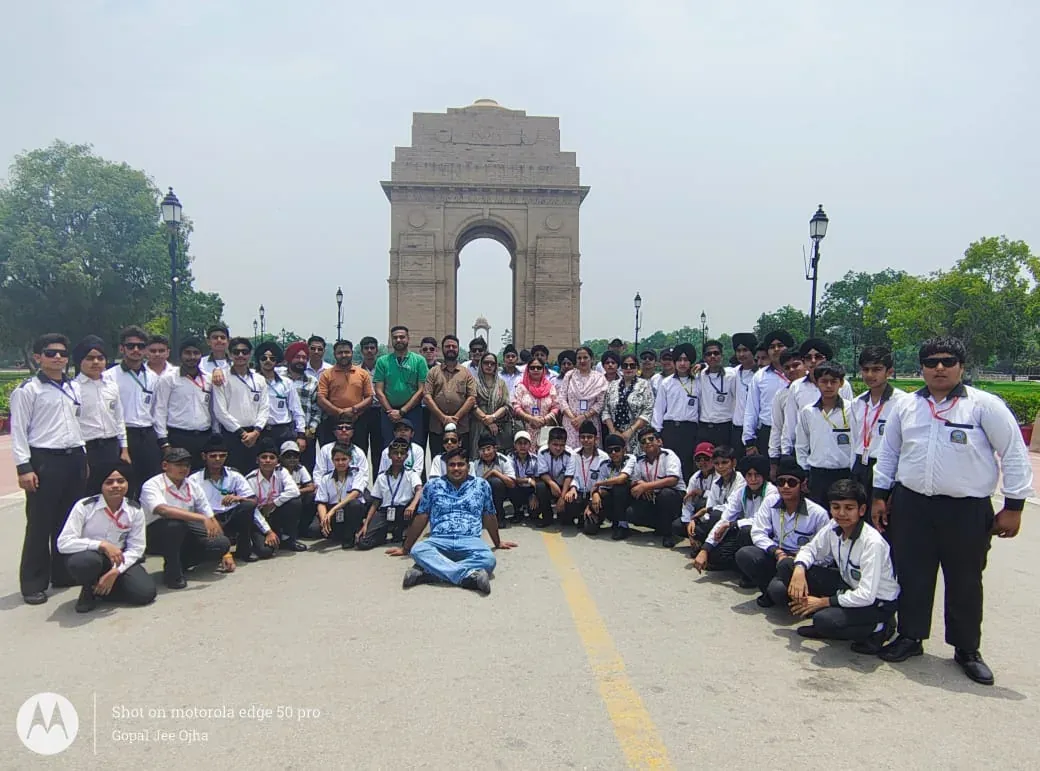
India Gate is free, has no gate to queue at and is open at all hours. Allow twenty to thirty minutes. It is best after dark, when it is floodlit and half of Delhi comes out to sit on the lawns.
It is a war memorial rather than a monument in the Mughal sense — designed by Edwin Lutyens and completed in 1931, commemorating around seventy thousand Indian soldiers who died in the First World War and the Third Anglo-Afghan War. The names of more than thirteen thousand of them are cut into the stone.
Practicalities
There is nothing to book, nothing to pay and no opening hour to work around, which makes it the easiest thing in Delhi to fit in. It is also the least rewarding in the middle of the day, when the lawns are hot, exposed and empty.
In the evening it becomes something else. Families arrive, ice-cream sellers set up, children run on the grass, and the memorial is lit. On a warm night it is one of the best places in the city to watch Delhi being itself.
| Open | Always — it is an open public space |
| Entry | Free |
| Time to allow | 20 – 30 minutes |
| Best time | After dark, when it is lit and busy |
| Closed | Not as such, but the area shuts for Republic Day rehearsals through much of January |
| Nearest Metro | Central Secretariat (Yellow and Violet Lines), then a walk or short ride |
| Worth a stop or a drive-past? | A stop in the evening; a drive-past in daylight |
What it commemorates
The arch was built as the All India War Memorial, for Indian soldiers who died fighting for the British Empire between 1914 and 1921 — in France, Flanders, Mesopotamia, Persia, East Africa and Gallipoli, and in the Third Anglo-Afghan War. Around seventy thousand died; 13,300 names are inscribed, including some British soldiers.
That history sits awkwardly and the memorial has been repeatedly reinterpreted since independence, which is part of what makes it interesting rather than a difficulty to be smoothed over.
The Amar Jawan Jyoti — the eternal flame for the unknown soldier — was added beneath the arch in 1972, after the 1971 war. In January 2022 it was merged with the flame at the National War Memorial a short distance away, which now serves as India's principal memorial to soldiers killed since independence and is worth the five-minute walk.
The canopy behind it
A short distance behind the arch stands an empty-looking domed canopy, also by Lutyens. It held a statue of King George V until 1968, when the statue was removed to Coronation Park in north Delhi, where it still stands among other displaced colonial statuary.
The canopy stood empty for more than fifty years. In 2022 a statue of Subhas Chandra Bose was installed beneath it.
Between the arch, the flame that moved, the statue that left and the statue that arrived, the hundred metres around India Gate is the most legible place in Delhi to read how the country has thought about its own past. Almost every visitor photographs the arch and walks past all of it.
Getting there, and what is nearby
Central Secretariat on the Yellow and Violet lines is the nearest useful station, then a walk or a short ride. By road it is central and easy, though the whole area is one-way systems and parking restrictions — this is a stop where having a driver who waits is worth more than usual.
Kartavya Path — the ceremonial avenue, renamed from Rajpath in 2022 — runs from the arch up to Rashtrapati Bhavan, the presidential residence, with the North and South Blocks on either side. The full walk is longer than it looks, close to two kilometres, and in summer that matters.
The National War Memorial is a few minutes away. Lodhi Garden and Humayun's Tomb are fifteen to twenty minutes by road, which is how India Gate usually fits a day — a stop between the south and the centre rather than a destination of its own.
Common questions
What are India Gate timings?
There are none — it is an open public space with no gate, no ticket and no closing time. Allow twenty to thirty minutes. The one exception is January, when Republic Day rehearsals close Kartavya Path and the surrounding area for roughly ten days before 26 January.
Is there an entry fee for India Gate?
No. It is free and always accessible. There is nothing to book and no queue. The lawns around it are public and in the evening they fill with families, which is when the place is at its best.
What does India Gate commemorate?
Around seventy thousand Indian soldiers who died fighting for the British Empire between 1914 and 1921 — in the First World War and the Third Anglo-Afghan War. More than thirteen thousand names are inscribed on it. The Amar Jawan Jyoti beneath the arch was added in 1972 and in 2022 was merged with the flame at the National War Memorial nearby.
What is the best time to visit India Gate?
After dark. It is floodlit, the lawns fill with families and food sellers, and the temperature is bearable. In the middle of the day it is an exposed arch on a hot open space, and a drive-past is enough. Winter evenings are cold but the place is still busy.
Why is the canopy behind India Gate important?
It held a statue of King George V until 1968, when it was moved to Coronation Park in north Delhi. The canopy then stood empty for over fifty years, and in 2022 a statue of Subhas Chandra Bose was installed there. Between the memorial, the flame that moved and the statues that left and arrived, this hundred metres is the clearest place in Delhi to read how the country has reinterpreted its own history.