Last updated 5 October 2026
Sunrise, and it is not a close contest. The first hour after opening has a fraction of the crowds, the best light the marble ever gets, and air cool enough to stand in.
Sunset is the reasonable alternative and genuinely better for one kind of visitor. Midday is what you get if you did not plan, and it is the version of the Taj Mahal that people describe as overrated. Here is the comparison in full.
The three times compared
| Sunrise | Midday | Sunset | |
|---|---|---|---|
| Crowds | Lightest of the day | Heaviest | Heavy, thinning near closing |
| Light on the marble | Pink to gold, soft | Flat and white | Warm gold, then grey |
| Temperature | Coolest | Hottest — marble burns in summer | Falling but still warm |
| Queue at the gate | Short if you arrive before opening | Longest | Moderate |
| Photography | Best, by a distance | Harshest | Good, but with people in frame |
| Suits | Almost everyone | Nobody, really | Late risers, second visits, overnight stays |
Why sunrise wins
The Taj Mahal opens about thirty minutes before sunrise, which moves through the year — roughly 6:00 AM in midwinter and closer to 5:30 AM in high summer. Confirm the date you are going rather than working from a number in an article.
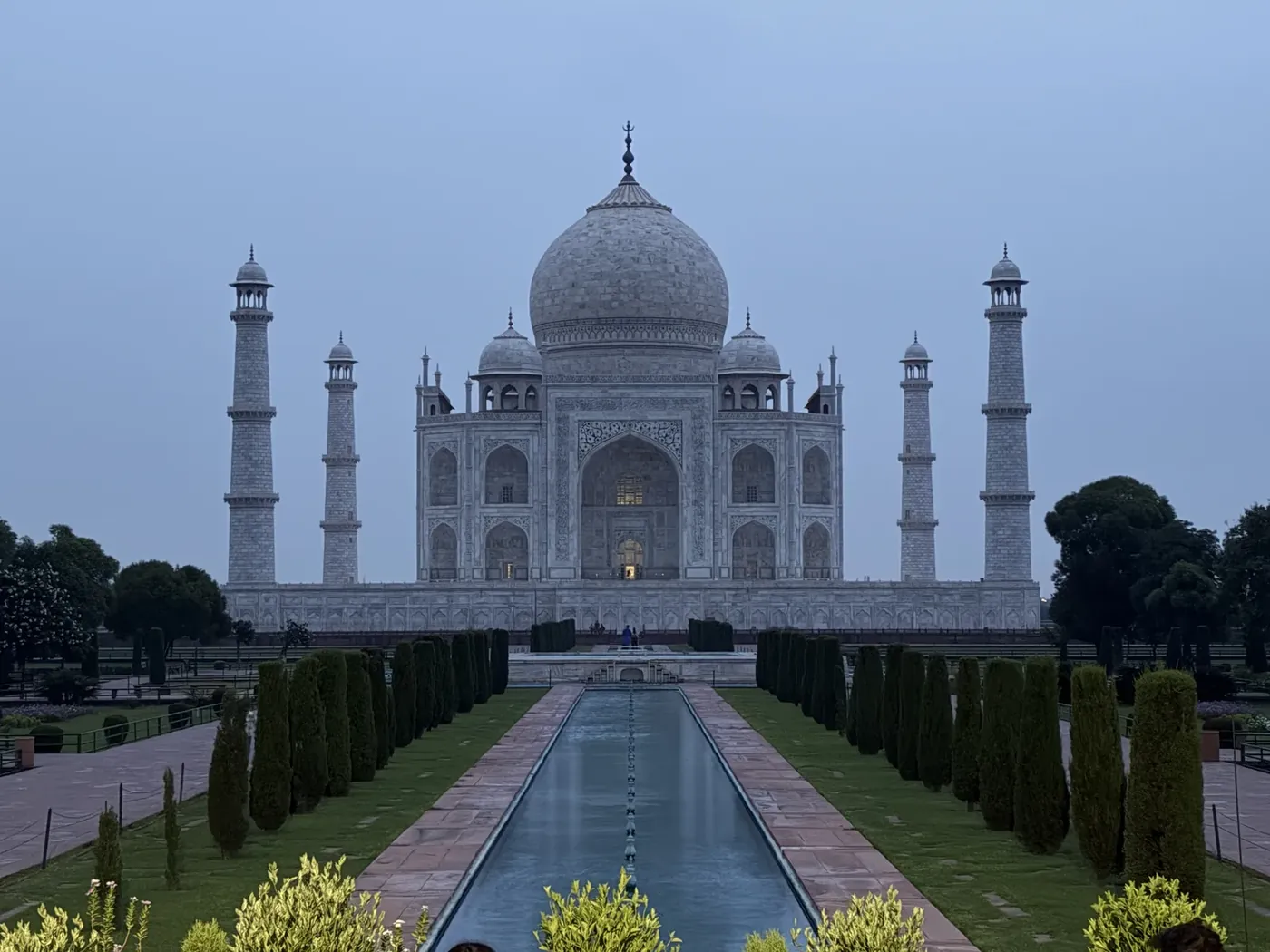
Three things happen in that first hour that do not happen again. The crowd is a small fraction of the day’s total, because most people are not willing to get up for it. The marble moves through pink and cream into white as the sun comes up, which is the effect the stone was chosen for. And it is cool, which in Agra between April and September is not a small matter.
The cost is the alarm clock. From Delhi, sunrise means leaving at around 3:00 AM, which only works by road — no train arrives early enough. From a hotel in Agra it means a 5:00 AM start and a short drive.
Our sunrise guide covers the gates, the queue and what actually happens when you get there.
When sunset is the better choice
Sunset is not a consolation prize. For some visitors it is the right answer.
The monument closes about thirty minutes before sunset, so the last hour has warm, low light coming across the facade, and the crowd thins steadily as people leave. If you are staying in Agra overnight it costs you nothing — you can do sunset on the day you arrive and sunrise the next morning, which is the only sensible way to see both.
It also works if you simply will not enjoy a 3:00 AM start. A visit you resent is worse than a visit in imperfect light, and nobody should be talked into dawn by a website.
The downsides are real though. It is busier than sunrise, the light goes quickly at the end, and in winter the haze that sits over north India tends to flatten the sunset more than it flattens the sunrise.
Why midday is the worst of it
Between about ten in the morning and three in the afternoon you get every disadvantage at once.
The crowd is at its peak, because the day trips from Delhi have arrived and the tour buses are in. The sun is directly overhead, which flattens the marble into a single hard white and removes every shadow that gives the inlay its depth. And in summer it is genuinely punishing — the courtyard has almost no shade, and shoes must be removed or covered on the platform, which on a 44°C day means marble you cannot stand on.
If midday is the only slot you have, go anyway — it is still the Taj Mahal. But understand that you are seeing it in the worst conditions it offers, and that most of the people who come away calling it overrated saw it exactly like this.
Night viewing on full-moon nights
There is a fourth option that few visitors know about. The Taj Mahal opens for night viewing on a small number of nights each month around the full moon — the full-moon night itself and the two nights either side of it.
It is tightly limited. Tickets are sold separately and in advance from the ASI office rather than at the gate, numbers per slot are capped, viewing time is short, and you see the monument from a distance rather than walking the grounds freely. It does not run on Fridays, and it is suspended during Ramadan.
Treat the details as something to confirm rather than rely on, because the rules and the ticketing arrangements change. If the dates of your trip happen to fall on a full moon and the idea appeals, ask us and we will find out what is actually running.
Which should you choose?
- First visit, any season — sunrise. There is no serious argument against it
- Staying overnight in Agra — sunset on arrival, sunrise the next morning
- Travelling May to September — sunrise, firmly; midday heat on open marble is genuinely unpleasant
- Not willing to start at 3:00 AM from Delhi — sunset, and enjoy it rather than regretting the dawn
- Serious about photography — sunrise, and be at the gate before it opens
- Day trip from Delhi arriving late morning — go anyway, but keep expectations level
- Dates fall on a full moon — ask about night viewing as an extra, not as the main event
Common questions
What is the best time of day to visit the Taj Mahal?
Sunrise, clearly. The first hour after opening has the lightest crowds of the day, the softest light on the marble, and the coolest air — which between April and September matters a great deal. The monument opens roughly thirty minutes before sunrise, so aim to be at the gate twenty minutes before that.
Is the Taj Mahal better at sunrise or sunset?
Sunrise for crowds, light and temperature. Sunset for anyone staying overnight in Agra, or anyone who simply will not enjoy a 3:00 AM start from Delhi. If you are in Agra for a night you can have both — sunset on the day you arrive, sunrise the next morning.
What time does the Taj Mahal open?
About thirty minutes before sunrise, which moves through the year — roughly 6:00 AM in midwinter and nearer 5:30 AM in high summer. It closes about thirty minutes before sunset. Confirm the times for your date rather than relying on a figure in an article, and remember it is closed to tourists on Fridays.
Can you visit the Taj Mahal at night?
On a small number of nights each month — the full moon and the two nights either side of it. Tickets are sold separately and in advance through the ASI rather than at the gate, numbers are capped, viewing time is short and you see the monument from a distance. It does not run on Fridays or during Ramadan, and the arrangements change, so confirm rather than assume.
How early should I arrive at the Taj Mahal for sunrise?
Be at the gate twenty to thirty minutes before opening. The queue forms before the gates do, and the people at the front of it get the twenty minutes that make a sunrise visit worth the alarm clock — the main walkway almost empty. Arriving exactly at opening puts you behind several hundred people.
Is it worth visiting the Taj Mahal in the middle of the day?
It is still the Taj Mahal, so if midday is your only slot, go. But you get the heaviest crowds, overhead sun that flattens the marble and kills the inlay detail, and in summer a platform too hot to walk on. Most people who describe the monument as overrated saw it at exactly this hour.
Does the winter haze ruin the sunrise?
In December and January the Taj Mahal can sit in white mist until mid-morning, and on the worst days the sunrise effect does not really happen. It is unpredictable rather than certain — many winter mornings are clear. If your dates are fixed in midwinter, consider a visit on two consecutive mornings if the trip allows it.