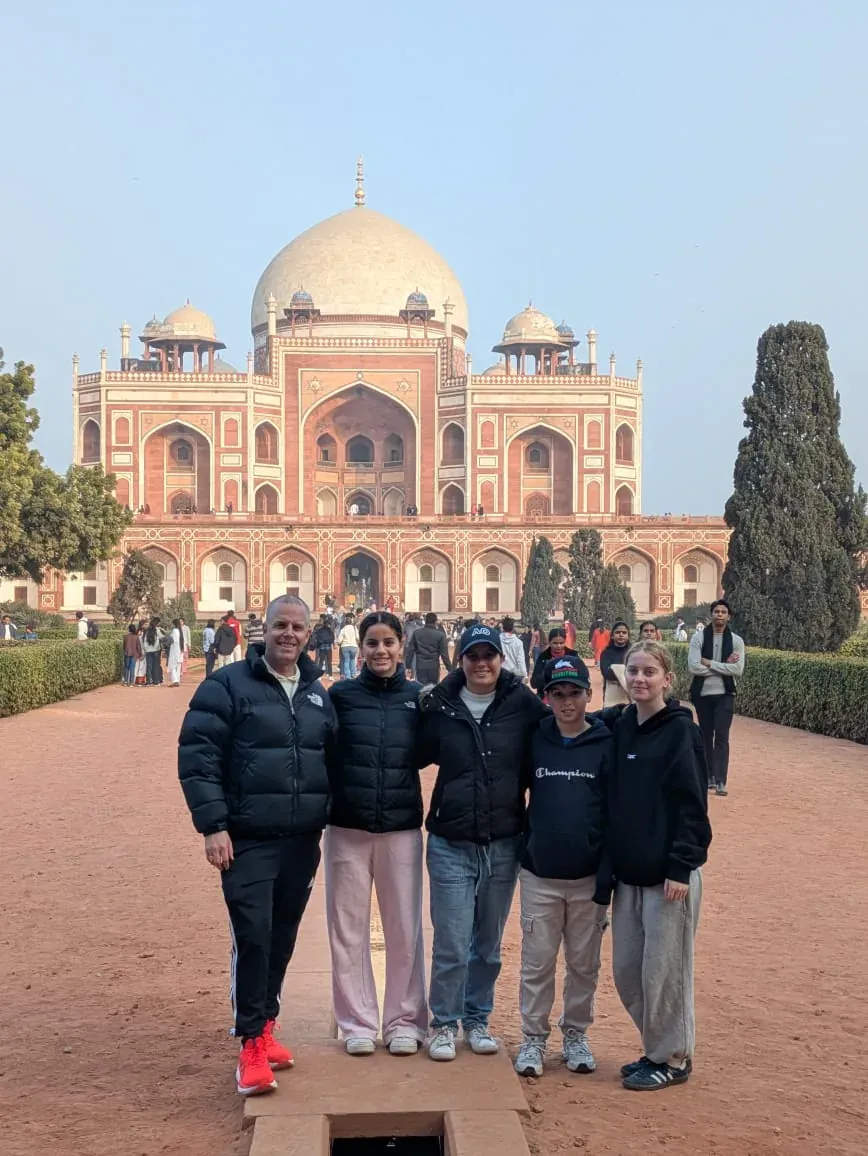
Last updated 29 September 2026
Humayun's Tomb is open every day from sunrise to sunset, needs about an hour and a half, and costs around ₹600 for foreign visitors and ₹35 for Indian citizens. It is roughly forty-five minutes from Delhi airport and twenty from Connaught Place.
It is also the reason the Taj Mahal looks the way it does. Built between 1565 and 1572, it was the first garden-tomb in the subcontinent — a domed mausoleum set at the centre of a walled charbagh divided by watercourses. Eighty years later Shah Jahan built the same idea in white marble at Agra.
Timings, tickets and how long to allow
Like Qutub Minar, it stays open on Mondays, which makes it one of the anchors of a Monday Delhi itinerary when the Red Fort and Akshardham are shut.
Come late in the afternoon if you can. The red sandstone and white marble go warm in low light and flat under midday sun, and the garden is at its best when the shadows are long.
| Open | Sunrise to sunset, every day |
| Closed | Never — open all week, including Monday |
| Entry, foreign visitor | around ₹600 |
| Entry, Indian citizen | around ₹35 |
| Time to allow | 1 – 1.5 hours |
| Nearest Metro | JLN Stadium or Jor Bagh, then a short auto ride |
| Best light | The last hour before sunset |
Why this building matters
Humayun was the second Mughal emperor, and he died in 1556 after falling down the stairs of his library. The tomb was commissioned by his widow, Bega Begum, who went to Mecca, returned, and spent the rest of her life on it — she is buried in the complex. It is one of the few great Mughal monuments built by a woman for a man, which is the reverse of the story everyone knows from Agra.
The architect was Mirak Mirza Ghiyas, brought from Persia, and the design imports the Persian charbagh — a garden quartered by four watercourses representing the rivers of paradise — and places the tomb at its centre. Nothing like it had been built in India before.
Every element the Taj Mahal is famous for is here first: the raised plinth, the great central dome, the arched recesses, the symmetry, the garden setting. Standing in front of it, you are looking at the draft.
It fell into serious disrepair and was restored in a major project led by the Aga Khan Trust for Culture, which also re-excavated the water channels. It is among the best-maintained Mughal sites in India as a result.
What else is inside the complex
Most visitors photograph the main tomb and leave, which misses about half of what is there. The complex holds several structures, some older than Humayun's Tomb itself.
- Isa Khan's tomb — an octagonal tomb and mosque from 1547, twenty years older than Humayun's and set in its own sunken garden. You pass it on the way in and most people walk straight past.
- The Barber's Tomb — a smaller domed tomb within the garden, traditionally said to belong to the royal barber, which tells you something about who was buried in an emperor's garden.
- Nila Gumbad — the blue-domed tomb just outside the eastern wall, recently reconnected to the complex after decades cut off by the railway line.
- The charbagh itself — the restored water channels run again, and the garden is the point rather than the setting.
Getting there, and what to pair it with
It sits in the Nizamuddin area of south-central Delhi, about twenty minutes from Connaught Place and forty-five from the airport. The Metro gets you close but not to the gate — JLN Stadium or Jor Bagh, then a short auto ride.
Pair it with Qutub Minar for an afternoon; they are on the same side of the city and both take late light well. Lodhi Garden is ten minutes away and is the calmest green space in central Delhi.
Nizamuddin Dargah is a few minutes' walk and is a working Sufi shrine rather than a monument — qawwali is sung there on Thursday evenings, and it is one of the most atmospheric hours in Delhi. It is a place of worship: shoes off, heads covered, and go with someone who knows the etiquette if you can.
Common questions
What are Humayun's Tomb timings?
Sunrise to sunset, every day of the week including Monday. Allow an hour to an hour and a half. It is one of the monuments worth building a Monday around, since the Red Fort, Akshardham, the Lotus Temple and the National Museum all close that day and this does not.
Is Humayun's Tomb the same as the Taj Mahal?
No, but the Taj Mahal exists in the shape it does because of it. Humayun's Tomb was built between 1565 and 1572 as the first garden-tomb in the subcontinent — a domed mausoleum on a raised plinth at the centre of a quartered Persian garden. Eighty years later Shah Jahan built the same idea in white marble at Agra. Seeing this first changes how the Taj Mahal reads.
How much is the Humayun's Tomb entry fee?
Around ₹600 for foreign visitors and ₹35 for Indian citizens, revised periodically by the Archaeological Survey, so treat those as indicative. Payment at the gate is digital rather than cash. Queues here are rarely the problem they are at the Red Fort.
Who built Humayun's Tomb and why?
Bega Begum, Humayun's widow, commissioned it after his death in 1556 and spent much of the rest of her life on the project; she is buried in the complex. The architect was Mirak Mirza Ghiyas, brought from Persia. It is one of the few great Mughal monuments built by a woman for a man — the reverse of the Taj Mahal story.
How long do you need at Humayun's Tomb?
An hour and a half covers it properly, including Isa Khan's tomb near the entrance, which is older than the main tomb and which most visitors walk straight past. An hour is enough for the main mausoleum and the garden alone. Come in the last hour before sunset if you can — the sandstone is a different colour then.